Monday, February 2, 2009

Blago: Oppression and Agency

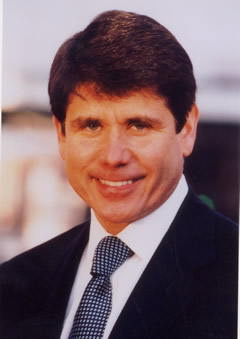
As we all know, Governor Rod Blagojevich has recently been impeached and effectively removed from office. His impeachment process was both very bothersome and seen as unfair by many Americans. There was definitely a lot of agency and oppression that occurred during his impeachment in my opinion.


OPPRESSION
1. The people were oppressed. Blago was found guilty of trying to sell the senate seat or at least discussing this. This is oppressing the people of Illinois because it is unfair. The people deserve a fair governor and a good senator.
2. In my opinion, Blago was oppressed. The hearing was unjust because the jury was biased. I don't believe anyone truly knew if he was actually going to sell the seat or if he was just talking about it. This is a crime, but in my opinion he doesn’t deserve to lose his job as governor necessarily or possibly lose his pension and go to prison. Also, the government recorded his phone conversations, which in my opinion violates our first amendment.

AGENCY
1. In some people’s opinion, Blago has oppressed the people of Illinois by even discussing the sale of the vacant senate seat. He is taking away the people’s right to a just senator. This power has been given to him through his previous job, as the governor.

2. Personally, I believe that Blago was oppressed by our judiciary system, who obviously obtains power from our government. How can we leave the future of a man in the hands of biased, everyday people? Also, it wasn’t right record his phone calls and listening to his conversations.

MY VERDICT
I believe in order to limit oppression we should both watch our state and national representatives closely and improve our judiciary system. Corruption would be limited if we simply observed representatives a bit closer. Does this mean we should tap phones? Not necessarily because that could be seen as oppression. Also, I believe that a new system might be necessary. Countless innocents have been jailed or sent to their deaths and countless criminals have gotten off. We need technology such as lie detection software to make better decisions. But that’s just my opinion; what do you think? Do you think there could have been a better way to deal with the Blago situation?

Sunday, December 14, 2008

My Civil Disobedience


As a 16 year old, there are many driving laws to follow. There is the law that I can only have one person (not directly related to me) in the car. There is also a driving curfew of 10pm on weekdays and 11pm on weekends. Last weekend, I went to an event with my Youth Group, where we went down town for a scavenger hunt in limos. The problem was that were not supposed to get back to the temple until 11:30 and my parents couldn't pick me up. What should I do? Should I try to hurry up the event so we could get back before curfew? Thoreau states: "But if it is of such a nature that it requires you to be the agent of injustice to another, then, I say, break the law," (Thoreau 274). In Civil Disobedience Thoreau says that it is worse to do injustice upon someone else than to break the law. To me, this translates to: Don't hurry up the event, because it is unfair to your friends. So, in the end, I decided to break curfew. Was this the right decision? Well, since I didn't get caught, I guess it worked out. What would you have done?


I know that the rule about only driving one person at a time is rediculous. Why does it matter how many people are in the car or if they are related to you? I know many 16 year olds have broken this law, so why even have it? Should laws like this be followed? Why is J-Walking illegal? I'm not saying to break seemingly rediculous laws, rather I am questioning them. Is it "OK" to break curfew or drive with multiple people if the reason you are doing it is just. Do the ends justice the means? I believe in some cases they do. I am curious how many people follow these laws, even if they see them as rediculous. Do you follow the law or do you find yourself leaning towards civil disobedience?

Sunday, December 7, 2008

Simplicity in Education


After talking about simplicity this week in class, it seems that our society does not embrace anything remotely close to simplicity in our education system. As a junior, I am very interested in "the college search" and finding a school that suits me. I have found that there are so many schools! And getting into certain schools is increadibly difficult. So many schools nowadays require more than hard work and good grades, but good ACT or SAT scores, SAT II scores, teacher recommendations, unique essays and much more. This process is overwhelming.
When creating the typical day at New Trier in class last week, we defined that our person's (Talyor's) goal was to get into a "good college." This goal is much easier said than done. There are so many colleges! And sometimes it's not always fair. Maybe you didn't get in to Stanford because they needed a trombone player. This process, to me, goes against HDT's philosophy and desire for simplicity. Our educations system is so complicated! Is there really even a difference in going to Harvard or going to Illinois? Well, in our society a degree from Harvard will help you get a "good job," but isn't the education at Illinois still the same? Don't they have the same classes and books? So then why is our society divided into "good schools" and "bad schools" and why is it so hard to get into the "perfect school?" I guess it comes down to ambition and determination. If Taylor is determined enough to go to a certain school, (s)he will probably get in. So why not a simpler system? Would it be better if all students received the same education? What if all students went to the same school? Some people might see this as equality, others as communism, but in my opinion it would make the process of getting into college a lot simpler. The reason I would not be in favor of it is because finding your "perfect" college is fun. What do you think?

Sunday, November 23, 2008

Progress on Modern Day Issues


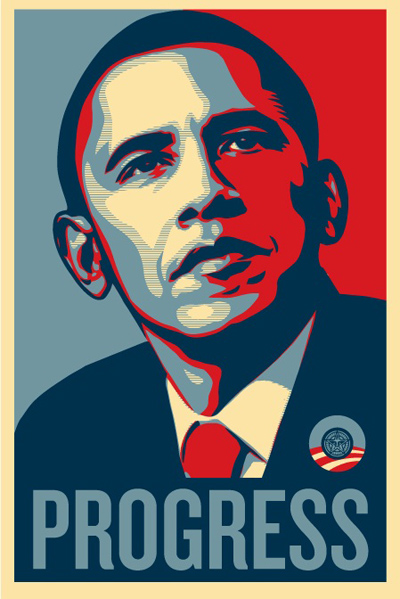
With the inaguration of the 44th president of the United States, change is immenent. President Elect Barack Obama has put forth plans to deal with many of today's national problems. Obama recognizes many of the modern day issues that we discussed in class on Friday. After Friday's discussion I felt compelled to not only better understand, but to inform about what our next president plans to do about these issues. Some of the major issues we came up with in class were education, health care and the environment. I found all of his plans on the official Obama website. His plans go as such:
Education:
He wants to heavily reform No Child Left Behind. Also, Obama plans to invest in childhood education, adequately fund all schools and get high-quality teachers at those schools. If done like promised, this could be major progress in the department of education. Hopefully, Obama's goals are not too idealistic, because education is important.
Health Care:
Obama is a big fan of universal health care. This means he wants equal and affordable health care for all. Hopefully we can call this progress. Although our nation preaches equality for all, universal health care is a big question mark. It does not seem to work in Canada, because there is a big need for doctors. This causes a lack of quality doctors, which makes their doctors "worse." Is Obama's plan progress? In my opinion: yes and no. According to Emerson, "society never advances. It recedes as fast on one side as it gains on the other," (Emerson 36). I feel this is very true with Obama's health care plan. It is progress to give everyone health care, but we regress when we add less capable doctors. Again, hopefully we are making "progress" or that our progress is more positive than negative.
Environment:
Personally, I feel that the issue of global warming is our most important issue and needs a lot more focus than it is being given. Obama wants to invest in alternate fuel sources and create 5 million more "green" jobs, but I don't think this is enough. If our environment goes, we all go.
Overall, I do think that progress is being made because these issues are being addressed. Previously, the issue of global warming has not received enough attention. I am optimistic that our changes for the future will help solve these problems.

Thursday, November 13, 2008

Technology Kills!


To many, technology may seem great. Most people simply embrace new technology, rather than question it. There are so many consequences, both positive and negative, that go along with new technology. After we talked about new technology in class yesterday, I could help but wonder if we will ever find out that these new technological devices are harmful. In our grandparents generation, smoking was considered the cool thing to do, just like having a cell phone, ipod or car is today. Now we know that cigarettes kill; will our grandchildren look back on us and say how could we use cell phones? Personally, I subconsciencely believe that we will look back and find that cell phones do cause tumors. Doctors at the Brain Tumor Center at Duke University think that my uncle's fatal brain tumor was formed from the overuse of his cell phone (along with the overuse of artificial sugars). After loosing an uncle, my family has become more hesitant to use cellular devices. My mom does not like when I carry my cell phone in my pocket either, because she thinks it will cause some sort of funky thigh tumors. She also prefers it when I use speaker phone becuase may reduce my risk of getting a brain tumor. Is she right? I don't know; I'm not a doctor. But I hope that she, along with numerous doctors who have these type of theories, is wrong so that my generation won't suffer.


Another technological issue that drives me crazy is new cars. Cars are flat out scary. The fact that pretty much any 16 year old kid can drive a car is even scarier. One of my (unamed) friends has hit 4 cars backing out of his drive way. Another one of my (unamed) friends has hit a fire-hydren, turned into the woods and hit a car on his way to school. Maybe my friends aren't the best drivers, but how can these kids be permitted to control automobiles that could kill someone. i have also heard that there are students at NTHS that drag race, which is extremely dangerous. I'm not saying that 16 year olds should not be given license; I am saying that modern day technology can have terrible consequences and should be taken used with care. Hopefully, I am worrying over nothing, but technology should not be taken lightly.

Thursday, November 6, 2008

The 26th Amendment: The Right To Vote


The 26th amendment states: "The right of citizens of the United States, who are eighteen years of age of older, to vote shall not be denied or abridged by the United States or by any State on account of age." Bottom line, anyone who is eighteen or older can vote. That means that some high school seniors can vote. Wow! Think about it; if we were all a year or two older we would be able to vote. How are we possibly old enough to know who is the best fit leader of our great nation? How are high school seniors old enough to know this? In the last couple of years, it seems a popular motto has been embraced by many celebrities and political activists: "Vote or Die!" (as seen on the left). I have some serious issues with this slogan and even this amendment.
To me, the motto encourages even those who have not done appropriate research or know anything about either canadite to vote. Is that what voting is about? To me, a presidential candidate should win because people truly support his/her views over those of his/her opponents. After asking many of my voting-eligable friends about their political preferences, it seemed that these kids knew very little, yet still had strong feelings. When asked why one (anonymous) student openly supported Barack Obama, he replied that he simply didn't want Governor Palin to be in the White House. When pressured further about his response, I found he had no information to back up his claim. Another student, who openly supported one (unamed) candidate told me that they supported him because their parents do. Another student told me that they supported a certain candidate because they agreed with his view. I was excited to finally hear a knowledgable response, but when I asked which views they supported, they told me "all of them; i don't know; i guess because my parents support them."
Although there were some students who were educated upon the viewpoints of the candidates, I was shocked at the overwhelming number of potential voters that knew practically nothing about either candidate. Honestly, I began to question whether we should raise the voting age, but why does it matter if the person is 18 or 21? If they don't take time to investigate at the age of 18, who's to say that they will when they are 21? For this reason, I strongly urge a new motto for voting: "Vote AND RESEARCH or Die." Hopefully more people will start to research both of the candidates in future elections, in order to elect the best and truly most supported candidate. I am optimistic that the choice of Barack Obama for president will be a good one, and hopefully the people who voted for him actually supported the views that he holds.

Sunday, November 2, 2008

13 Year Old Child Left in Nebraska


Last month, a mother from Michigan, drove her 13 year old son to Nebraska and left him there. As we discussed in class, Nebraska is the only state that has a safe-haven law that allows parents (or anyone else) to leave children at hospitals within the state until they are 18 years old. Government officials in Nebraska, according to an article in Tacoma Washington's News Tribune, say this law "should be used only for children in immediate danger." What does this mean? Why not put simply put your child or children up for adoption, instead of abandoning them? According to the article, an out of work, widower named Gary Slaton has abandoned 9 out of his 10 children at hospitals in Nebraska because he felt overwhelmed. Is this right? Since the law took effect in July, 18 children from states outside of Nebraska have been taken to and abandoned in Nebraska. Personally, I think that this is awful. How can a parent do this to their child? How can our government allow this to happen? There is a reason that the other 49 states do not implement this law, so then why doesn't the government interfere and strike it down in Nebraska?
Upon reading about Nebraska's safe-haven law, I wondered if it violated the Constitution or if taking this law away would be a violation of the Constitution. After looking over our Bill of Rights sheet from class, I felt that this issue related to two different amendments. First, I thought that the 8th amendment had a lot to do with Nebraska's safe-haven law. According to the article, many of the children or teenagers who are abandoned in Nebraska had uncontrollable behavioral problems. Abandonment is thus the parent's form of punishment. Does this violate the 8th amendment then? Can this be considered cruel and unusual punishment? I believe it is a very unusual punishment and that it is also cruel to leave a child in a different state due to behavioral problems. So yes, in my opinion it does violate the 8th amendment. Or is it a parents right to leave their child in Nebraska? Could this be considered part of the ninth amendment as a given right? Personally, I think that leaving your child in a different state is a cruel and unusual punishment. What do you think?